Saturday, December 17, 2011

Harmonica tablature

I now have compiled some 180 tabbed songs for chromatic harmonica which I have sourced substantially from two websites – harptabs and  harpinanawhinin .  My collection also include a few diatonic harmonica tabs which could become handy if and when I decide to try and learn to play the popular diatonic ten holers.


Harmonica tab.  Here is an example of a tab for the first verse of a popular Filipino love song, Ang Tangi Kong Pagibig (My One and  Only Love):

Key: Am (Chromatic)
 2        5         -4   -3        3* -4      -3   -3  -4    5      6   -5 
 Ang   ta-----ngi kong pag-i-----big ay minsan lamang
     -2 -5  5     -4      -3-3 3* -6    6  -4 -5   5  
 Ngunit ang 'yong akala   ay hindi tunay

    2  5     -4  -3  3* -4 -3    -3   -4    5  -5    6   -6  
  Hindi   ka  li--li--mutin magpakai--lan pa man

     -6  6      -5  5 6  -3 5-4 -5    3*  -4 -3
   Habang ako ay narito at may buhay.

In the above example, the number notation is supposed to be the  simulation of the hole position of the note in the harmonica.  In actuality it represents the note itself. The "2", for example, is an "E" in the lower octave for both diatonic and chromatic and is played as a blow note.  The rule is a positive number should be played as a blow note, while a negative number should be played as a draw note.  Number notations with an "asterisk", as in 3* above, (sometimes represented by '<" or "#"),  are to be played with the slider pushed in for chromatic harmonicas.

Tablature chart.  The complete tablature chart for a chromatic harmonica and the corresponding equivalent key of C in a diatonic harmonica is shown below:

NoteDiatonicChromatic
C11
C#1*1*
D-1-1
D#-1*-1*
E22
F-2"-2
F#-2*-2*
G3-23
G#3*3
A-3"-3
A#-3"*-3*
B-3-4
C4 3o4 5
C#4*4*5*
D-4-5
D#-4*-5*
E56
F-5-6
F#-5*-6*
G67
G#6*7*
A-6-7
A#-6*-7*
B-7-8
C78 9
C#7*8*9*
D-8-9
D#-8*-9*
E8-8o10
F-9-10
F#-9*-10*
G911
G#9*11*
A-10-11
A#-10*-11*
B10'-12
C1012
C#10*12*

Legend:
+ =blow
- = draw
* = slider in
' = half step bend
“ = two half step (whole step) bend
“' = three halfstep bend
o = overblow

The diatonic chart was lifted from harptabs which shows a complete musical notation  for diatonic harmonica under the name of W. M. Molino, while the chromatic chart was taken from theCoast2Coast. The slider-in notation (*) applies only to chromatic harmonica, while the bends and overblows apply only to diatonics. Sometimes the slider-in position is notated with the sign "<", or "#",  before or after the number notation. I do not use the sophisticated convention presented in angelfire because  some of the recommended usage conflict with the conventions I have adopted for use in my compilations.

Tabbiing Tools.  At the onset, I did not know that the tablature for diatonics is different from chromatics.  In several instances, while attempting to play a tabbed song in my Hero I would sometimes sense that the tabs do not seem to jibe with the familiar melody.  I would then reconstruct the tab with the help of the piano and use notes name.  The whole piece is then converted back to numeric tabs using the find and replace facility of the word processor. I did not realize then that what I was actually doing was convert diatonic tabs to chromatics.  

Here are some tools I use to tab a song:


I would initially established the key of the song by listening to a performer in youtube.  With the virtual piano in my ipad, I would  play the song line by line and record the melody in note-names in my desktop computer.  After completing the piece in note names, I would run the find and replace tool of the word processor and produce the chromatic tab for the song.  Then, I would use myHero chromatic harmonica, or the Echo Celeste for songs without semitones,  to test the final tab.

Eventually, with the help of generous members of harmonicaclub, I discovered that  a separate tab system is used for diatonics, and this is differentiated with notations for half (or full) steps for bending notes, including overblows. And so, after having gone through the rigors of unnecessary reconstruction and conversions , I finally learned to select only from my sources the tabs for chromatics and shied away from diatonic tabs. And while selecting only chromatic tabs for my collection, I finally realized that most of the tabs I have previously gathered were actually not "incorrect" but were accurately tabbed for a diatonic harmonica.  Of course, it took some time for me to understand this.

Using Notes Names.  One good thing that happened to me during the times that I had to convert "incorrect" diatonic tabs, was the exposure to note-names. Here is the tab in note-names for the above song:
   
E    [C] B    A    G# B A  A   B   [C]    [E]  [D]
 Ang tangi kong pag-ibig ay minsan lamang

 F [D] [C]     B     A A G# [F]   [E] B [D][C]
Ngunit   ang 'yong akala    ay   hindi tunay

E [C] B A G#B A   A   B[C][D]    [E]  [F]
Hindi ka lilimutin magpakailan pa man

[F]  [E]    [D]C] [E]   A[C]B [D] G#  B    A
Habang ako    ay narito   at  may buhay.
(n.b. The notes in brackets are played in the higher octave)

In doing the reconstruction of diatonic tabs to chromatics I became very familiar with the note-names.  The thought of using the notations to further improve my piano playing came to my mind.  So, I made sure that the note-names notations are also made part of the file alongside with the numeric tabs, together with the guitar chords for the songs.  In my experience, I have come to take the note names tab in the same degree of usage and acceptance as the numeric tabs because the blow and draw notes are really confined to specific notes.  The blow notes are C, C#, E, G and G#, while the draw notes are D, D#, F, F#, A , A# and B. I do not use the notation for flat notes, e.g., Eb, because it tends to confuse the major note.  For instance, Eb might be mistakenly played as a blow note because the  E note, is a blow note,  or the mistake could be made vice-versa.  Instead of Eb, I use D#, which is a draw, and the notation is consistent with the major note D, which is also a draw.

However, the numeric tab is superior to the note-name notation because the numbers with negative signs immediately alerts the player  that the note is a draw.  On the other hand, the note-name notation has the advantage of bridging the gap between the instrument and the music piece because the note names can prepare the player for a shift to an actual use of music notes sheet, without the need of providing for a separate harmonica tablature. The drawback is, if and when the key is changed to another, the numeric tabs will stay, but the note-name notation will have to be converted to follow the new key.


The Echo Celeste Tremolo

While I was undecided what chromatic harmonica to replace the Hero, I bought an Hohner Echo Celeste key of C for $16.00, for the purpose of recalling the martial and latin music I used to play in the Butterfly.


Like the Butterfly, the Echo Celeste is a tremolo.  I had no problem handling itbut the technique of tongue tapping the lower holes to produce an accompaniment effect is no longer there, although  I could still play the clear single notes.

Notes chart.  The Echo Celeste has 24 holes and on the top side are engraved the  numbers from 1 to 12, as shown in the image below:


The numbers indicate the position of 12 active slots composed of two holes each, which means the harmonica can produce 24 notes, making it a 3-octave instrument.

Compared to the Hero, the notes chart of the Echo Celeste is almost identical to the notes chart of the Hero with the slider out.  Here is the notes chart of the Echo Celeste:

The playable holes alternate with the blank holes for both upper and lower layer, and only one note can be played in each playable hole.  In other words, any hole in the above picture that has no indicated note is a blank hole.  No note can be played in this hole, whether blow or draw.  This is the same architecture as the "slider out" notes of  the Hero, and in this sense the two harmonicas are practically identical.

I easily got tired of the Echo Celeste because most of the tabbed songs I have compiled could not be played properly because of semitones - i.e., flats and sharps.  As soon as I got my first Hohner Super Chromonica Chromatic 270/48, I decided to hand over the Echo Celeste to my grandson.

In the meantime that my orders have not arrived, I thought of exploring the inside of the Echo Celeste. I unscrewed the cover and the first thing I noticed were the screws that attach the reeds plates to the comb.  The idea that the construction is more advance than the Super Chromonica 270 got into my mind and immediately I got an inkling that perhaps the comb is not wood like the older 270/48 , but synthetic or plastic.  I continued to unscrew the rest and presto, a very modern harmonica comes into view.


Architecture.  Shown below is the diassembled view of the Echo Celeste.


The architecture is solid – plastic comb with thick (1mm) reeds plate, attached to the comb by ten miniature screws that thread to the opposite reeds plate. This design allows complete access to the innermost section of the harmonica and makes cleaning and sanitizing a very easy operation. Compared to the Hero, the Echo Celeste is durable and far superior in construction.


It's been a long time since I played a C tremolo so I tried to do the tongue tapping technique on a medley of Filipino folk music - Doon po sa amin, Leron-leron sinta, Pamulenawen, Magtanim ay di biro, Aten ku pung singsing, Sitsiritsit alibangbang, and Bahay kubo, and this is how the Echo Celeste responded:


Looks like I could still do it, so I thought I must have one really good tremolo and all of a sudden my grandson lost his harmonica.  I will probably buy him a shorter, one-octave chromatic harmonica, which he says he prefers,  for a Christmas gift.


The Hero Chromatic

As soon as I arrived in NJ by end August, 2011,  I started looking for an appropriate harmonica.  I did not want to spend so much money on my first purchase for fear of wasting it if I suddently lose interest.  Having fixed myself on a chromatic harmonica, its ability to play all notes, I surfed the internet for the cheapest I can find. I saw on eBay a  Hero brand chromatic harmonica, made in China, which I bought new for $12.00 plus shipping charges of $10.00.


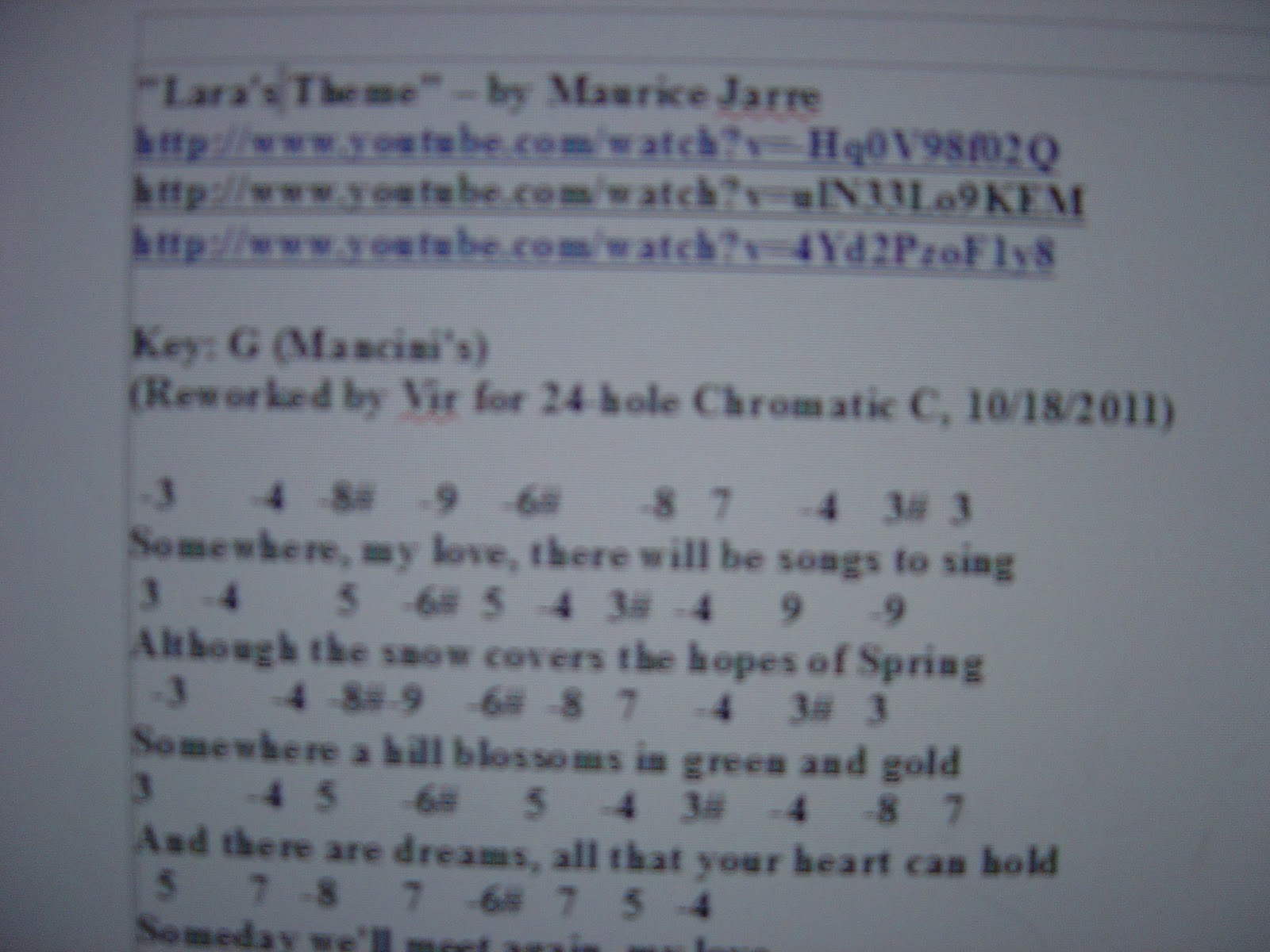
I already had some tabbed songs ready so I tried playing Some Enchanted Evening, Lara's Theme and Speak Softly Love.  I noticed that the Hero has a peculiar notes arrangement.  There are 24 holes and only two notes can be played in a hole, which means all in all 48 notes can be played, which makes it a 3-octave harmonica.  Unlike other designs, only one note can be played in a hole,which could either be a  blow or draw, but not both, with the slider out, and another note, with the slider in.

Notes chart.  Here is the notes chart of the Hero:


I realize then I could follow the notations and play the songs without difficutly but I  experienced  breathing problems because I seem to use a lot of air.  In fact, it was like a test of endurance to finish a song before I had to stop and really take a deep breath.

Playing the Hero.  Here is a video in which I play the song, Speak Softly Love in Dm,  on the Hero  :


The problem was too much air leak.   To find out where the leak could possibly come from I decided to disassemble the harmonica.  The mouthpiece is fastened by two screws and after taking it off I could already guess the architecture - the mouthpiece is plastic with the edges upturned a little where slider fits, and the assembly sits on top of the plastic comb.  I suspected that the air leak must be coming from around the comb and the mouthpiece because there are no seals such as the windsavers found in Hohner chromatics. The only option I had was to tighten the screws harder upon reassembly, but in this condition the slider would not work.  So, I had no  alternative but make do with a loose mouthpiece and inhale more air than not having a working harmonica to play with.

Architecture.  One good point in favor of the Hero is the accessablity of the comb and the reeds for easy cleaning, maintenance, repair or tuning.  It has 24-slots with 2 holes each, one set of 24 notes with slider out and another set of 24 notes with slider in.  The architecture is simple - comb is plastic and reeds plate is screwed to the opposite plate; the slider fits under the plastic mouthpiece which is screwed on top of comb.

Shown below is a fully disassembled Hero.


Saving for spare parts.  At this point, I thought I needed a better chromatic harmonica.  I was about made up to dispose of the Hero, but then I read in a forum that old harmonicas should not be thrown away because these are good sources of replacement reeds.  So, the Hero is still with me and the Raritan Valley Authority had been deprived of one disposable harmonica.  In retrospect, the Hero led me into  what I call the harmonica wilderness - the tablatures, the diatonic, chromatic, and notes chart and tuning, at the same time it gave me an assurance that indeed I could probably use a chromatic harmonica.

Looking back

My name is Vir Leynes and I learned to play the harmonica when I was seven years old in the far away islands of the Philippines, in a small town named Iba, in the coastal province of Zambales.   


Introduction to harmonica. A playmate had a one-octave Hohner harmonica and I was so curious while he played a military bugle song.


 He lent me the harmonica and taught me the basic blow and draw notes.  And this sharing of the harmonica started my love for the instrument.  When my father saw I was very interested he bought me the first harmonica that I really liked, a Japanese-made Butterfly, a 21-hole tremolo.  


Early harmonica activity. While in grade school, I organized a group of five or six boys and called ourselves the cumbancheros, each one holding a sort of musical instrument, and I played the lead instrument, the harmonica, and we were often guest in school programs providing some sort of martial and latin music.  During special feast days like All Saints Day, Christmas day or feast days, our group would play from one house to another,  and those inside would spare us a few coins, sometimes,  more than what we expected, and we divide our sort of earnings for the night equally among ourselves.

The group stayed together until I was in high school, and as soon as I entered college in the capital city of Manila I stopped playing harmonica altogether and forgot all about it.  I was fifteen years old then.

I am now sixty-nine years old and retired, and perhaps a little bit late in re-entering the very intriguing world of this amazing instrument, the harmonica.  Very haphazardly, perhaps abetted by sheer eagerness, I bought a Chinese made cheap chromatic harmonica, the Hero. And for the first time in more than fifty years, I again held a harmonica in my hands.


Going chromatic. I did quite an exhaustive research on the internet and learned about chromatic and diatonic harmonicas. Back in my youth, I thought harmonicas could not be made to play songs that are not in the key of C, otherwise the player would be arduously spending more time finding notes than playing.  I was too limited to key of C termolo back then and no one told me (no internet yet to provide answers), that there are such things as chromatic harmonicas that can play all notes. Only lately did I understand about keys as these apply to harmonicas.  What could have been my level of expertise today if in my youth I was already playing a chromatic?

Learning about tabs.  I also learned about tablature, or tabs for short, for both diatonic and chromatic.  I started compiling selected tabbed songs copied from very good sites, stocked them up into my ipad so I can have the convenience of referring to any of the songs with ease while playing.


Diatonic techniques.  I also tried bending notes.  I remember my uncle, who introduced me to the Butterfly, he used to do bends in his tremolo while playing the popular Filipino classic, Sa Kabukiran, and taught me how to do it, with the intent of actually aping the sound of the semitone.  Sometimes, I thought I already had it, but whenever I bend notes in a song, I fail to produce the missing note.  Perhaps a lot more practice would eventually bring this special technique forward.


Taking the harmonica apart.  Having been a mechanics and RC model hobbyist I also looked into the internal structure of the chromatic and diatonic harmonica to fully understand the function of each part and learned to clean and maintain the harmonica.

Present collection.  I now have at my disposal three Hohner Super Chromonica Chromatic 270/48, one Hohner 64 Chromonica 280, a set of 7 Swan 1020 diatonic blues harmonica (keys C,D,E,F,G,A and B), a Swan 1664-2 Chromatic, a 24-hole Hero chromatic, and a 24-hole Hohner Echo Celeste Tremolo With these in my arsenal, I hope to revive my interest in harmonica with a lot more vigor and time to spare than ever.